
TEJ2O COURSE OUTLINE
Course Title: Computer Technology
Grade: Open
Ministry Course Code: TEJ2O
Course Type: Open
Credit Value: 1.00
Course Hours: 110
Department: Technological Education
Revision Date: N/A
Policy Document: The Ontario Curriculum Grades 9 and 10: The Arts, 2010

Domestic Student Price: $550
International Student Price: $799
COURSE DESCRIPTION
This course introduces students to computer systems, networking, and interfacing, as well as electronics and robotics. Students will assemble, repair, and configure computers with various types of operating systems and application software. Students will build small electronic circuits and write computer programs to control simple peripheral devices or robots. Students will also develop an awareness of related environmental and societal issues, and will learn about secondary and postsecondary pathways and career opportunities in computer technology.
OVERALL EXPECTATIONS
A. Computer Technology Fundamentals
· A1. identify and describe the functions of, as well as important advances related to, electronic and computer components;
· A2. demonstrate a basic understanding of computer networks and their components;
· A3. demonstrate a basic understanding of binary numbers and digital logic.
B. Computer Technology Skills
· B1. install and configure the hardware and operating system of a workstation, and use file-management
techniques effectively;
· B2. construct and test simple interfaces and other electronic circuits;
· B3. assemble and configure a simple computer network;
· B4. install and use a variety of software;
· B5. apply fundamental programming concepts to develop a variety of simple programs, including a
· program to control an external device.
C. Technology, the Environment, and Society
· C1. identify harmful effects of the widespread use of computers and associated technologies on the
environment, as well as agencies that reduce these effects;
· C2. identify effects of the widespread use of computers and associated technologies on society.
D. Professional Practice and Career Opportunities
· D1. follow appropriate health and safety procedures when assembling, using, and maintaining
computer systems;
· D2. demonstrate an understanding of ethical and security issues related to the use of computers;
· D3. identify various careers related to computer technology, and describe the education and/or training
required for them.
OUTLINE OF COURSE CONTENT
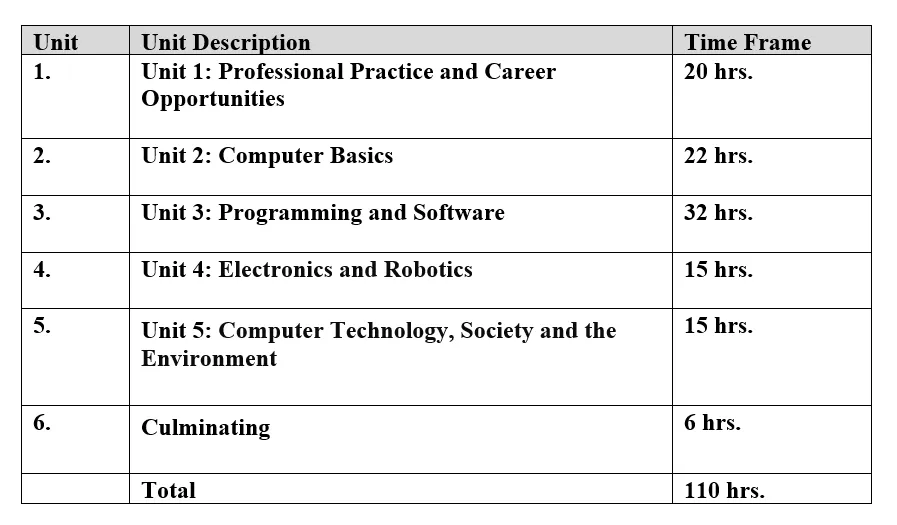
TEACHING AND LEARNING STRATEGIES
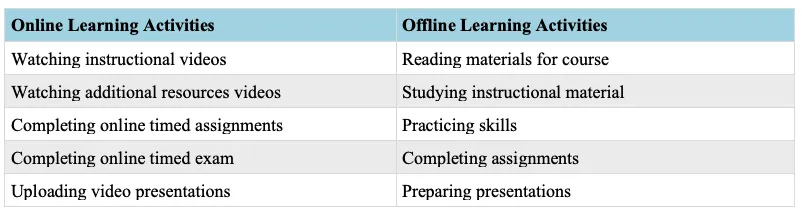
A variety of teaching and learning strategies are used to allow students many opportunities to attain the necessary skills for success in this course and in future studies. In all activities, consideration will be taken to ensure that individual students’ multiple intelligences and learning strengths are addressed through the use of varied and multiple activities in each lesson.
STRATEGIES FOR ASSESSMENT AND EVALUATION OF STUDENT PERFORMANCE
The primary purpose of assessment and evaluation is to improve student learning. Assessment and evaluation is based on the Ministry of Education’s Growing Success policy document, which articulates the Ministry’s vision for how assessment and evaluation is practiced in Ontario schools.
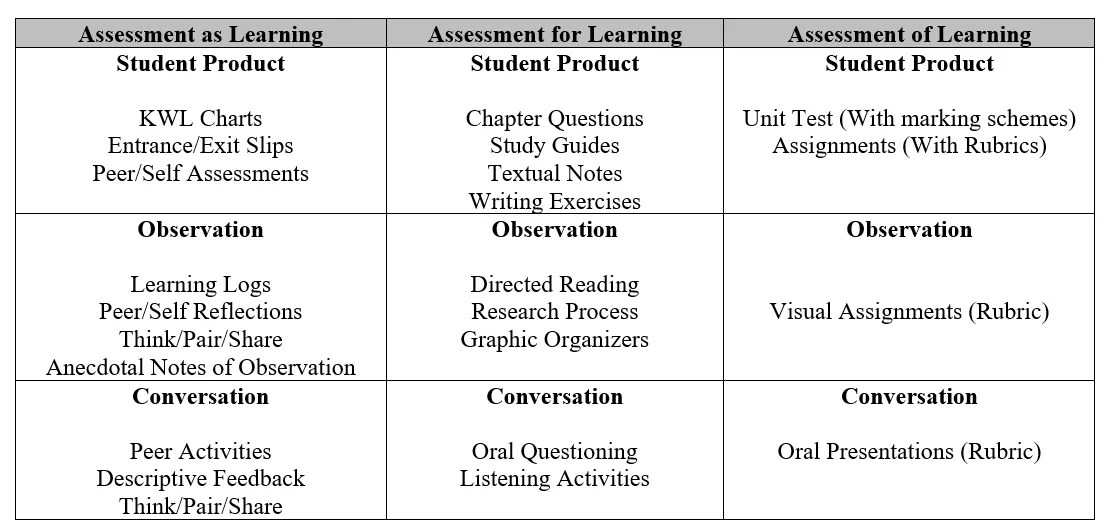
Growing Success describes the three assessment types as follows:
Assessment as Learning: focuses on the explicit fostering of students’ capacity over time to be their own best assessors, but teachers need to start by presenting and modelling external, structured opportunities for students to assess themselves.
Assessment for Learning: the process of seeking and interpreting evidence for use by learners and their teachers to decide where the learners are in their learning, where they need to go, and how best to get there.
Assessment of Learning: the assessment that becomes public and results in statements or symbols about how well students are learning.
ASSESSMENT AND EVALUATION
EVALUATION SCHEME
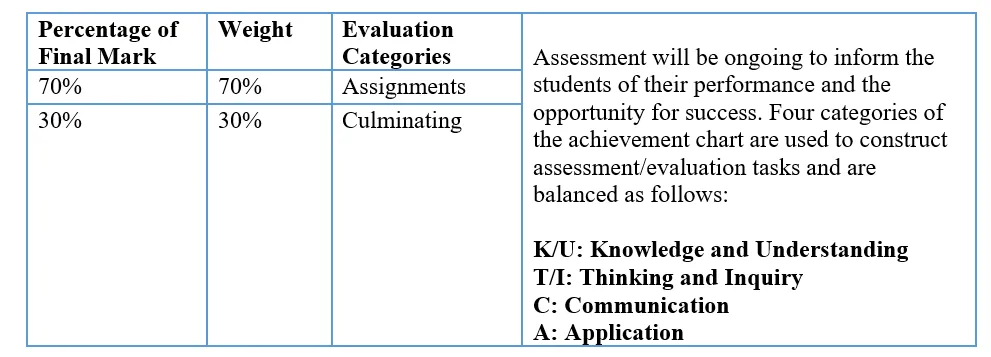
A final grade (percentage mark) is calculated at the end of the course and reflects the quality of the student’s achievement of the overall expectations of the course, in accordance with the provincial curriculum.
The final grade will be determined as follows:
Seventy percent (70%) of the grade will be based on evaluation conducted throughout the course. This portion of the grade should reflect the student’s most consistent level of achievement throughout the course, although special consideration should be given to more recent evidence of achievement.
Thirty percent (30%) of the grade will be based on a final evaluation administered at or towards the end of the course. This evaluation will be based on evidence from one or a combination of the following: an examination, a performance, an essay, and/or another method of evaluation suitable to the course content. The final evaluation allows the student an opportunity to demonstrate comprehensive achievement of the overall expectations for the course.
PLAGIARISM
Plagiarism is a serious offense. It is defined as taking words, phrasing, sentence structure, or any other element of the expression of another person’s ideas, and using them as if they were your own. Plagiarism is a violation of another person’s rights, whether the material taken is great or small.Students will be assisted in developing strategies and techniques to avoid plagiarism. They need to be aware that plagiarized term work will be penalized and could result in a mark of zero.
NEW!
SBI3U
SCH4U
ENG4U
ENG3U
SBI4U
MDM4U
MCR3U
BBB4M
BOH4M
MHF4U
We offer a hybrid model of education for all of our online courses, you can earn your OSSD with us!
How We Help Students

Complete Prerequisites
as you work toward your Ontario Secondary School Diploma
Earn
as you work toward your Ontario Secondary School Diploma
Retake
a course you had trouble with
Meet
a course you had trouble with
Take
a course not offered
In your home school
Trust
a course not offered
In your home school
Spark Asher Academy Alumni University Destinations